
Chapter 08 of 10
Consistency Across an API
Why the same decision has to appear at every endpoint, why intention is not a mechanism, and the three things that actually hold a convention in place over time.
Every chapter before this one ends in a decision. This chapter is about the fact that a decision made once and applied unevenly is worth less than a worse decision applied everywhere.
Consistency is the thing callers actually experience
Nobody integrating with your API evaluates your pagination style in isolation. They notice how many times they had to learn something new.
An API where every list pages the same way, every error has the same shape and every timestamp has the same name can be learned once. The fourth endpoint costs almost nothing, because the caller is guessing correctly. An API assembled from individually reasonable decisions costs them a fresh reading every time, and the cost is invisible to you because it lands entirely on the other side.
This is why the guide keeps saying that two close options are less important than picking one. The gap between cursor and offset is real and small, while the gap between one pagination style and three is neither.
Intention is not a mechanism
Teams do not become inconsistent through disagreement. They become inconsistent through turnover, deadlines and the ordinary fact that the person writing the fifteenth endpoint was not in the room for the first.
A written convention alone therefore decays predictably. It is read once during onboarding, it is not in front of anyone at the moment a decision is made, and nothing happens when it is ignored. Six months later the document describes an API that no longer exists, which makes it worse than nothing, because now people distrust it.
Holding a convention in place needs three things working together.
Something written down gives the team an artefact to argue with and change deliberately. It is the cheapest of the three and the least effective on its own.
A reusable building block makes the agreed shape the path of least resistance. When the error response is a component you reference, writing a different one is more work than complying, which is the only reliable form of encouragement.
An automated check catches what the other two missed and does it where the decision is being made. A check that runs in a nightly report is a list nobody reads, while a check that runs while somebody types is a correction.
What to make reusable, and when
The instinct after reading the above is to extract everything, which produces an API description that is technically tidy and genuinely hard to read.
The signal to extract is the second occurrence rather than a feeling that a shape looks reusable. Three cases are worth extracting on sight because the second occurrence is certain, and those are the error body, the pagination envelope and the authentication scheme. Everything else can wait until it repeats. The components chapter of the OpenAPI guide covers where that line sits in the document itself.
Reuse across APIs is a different decision with a different failure mode. One definition shared by twelve services means a change reaches all twelve at once. That is right when the definition is a genuine standard and wrong when it is not, since nobody chose to receive it. A library that copies the definition and records where it came from lets each consumer move on its own schedule, and the price is that versions coexist for a while.
Promote rules slowly
A style guide switched on over an existing API produces a large number of violations on the first run, and how you handle that first number decides whether the guide survives.
Turning everything into a blocker stops work and teaches people to route around the check. Leaving everything advisory means the number only grows, because nothing ever has to be fixed. The path that works is to start advisory, work the backlog down, and then promote the handful of rules you are genuinely unwilling to ship without.
That handful is usually smaller than expected. Unique operation identifiers and declared error responses earn their place quickly, while a naming convention on descriptions rarely does.
In Routebase
The three mechanisms map onto three surfaces, and they are meant to be used together.
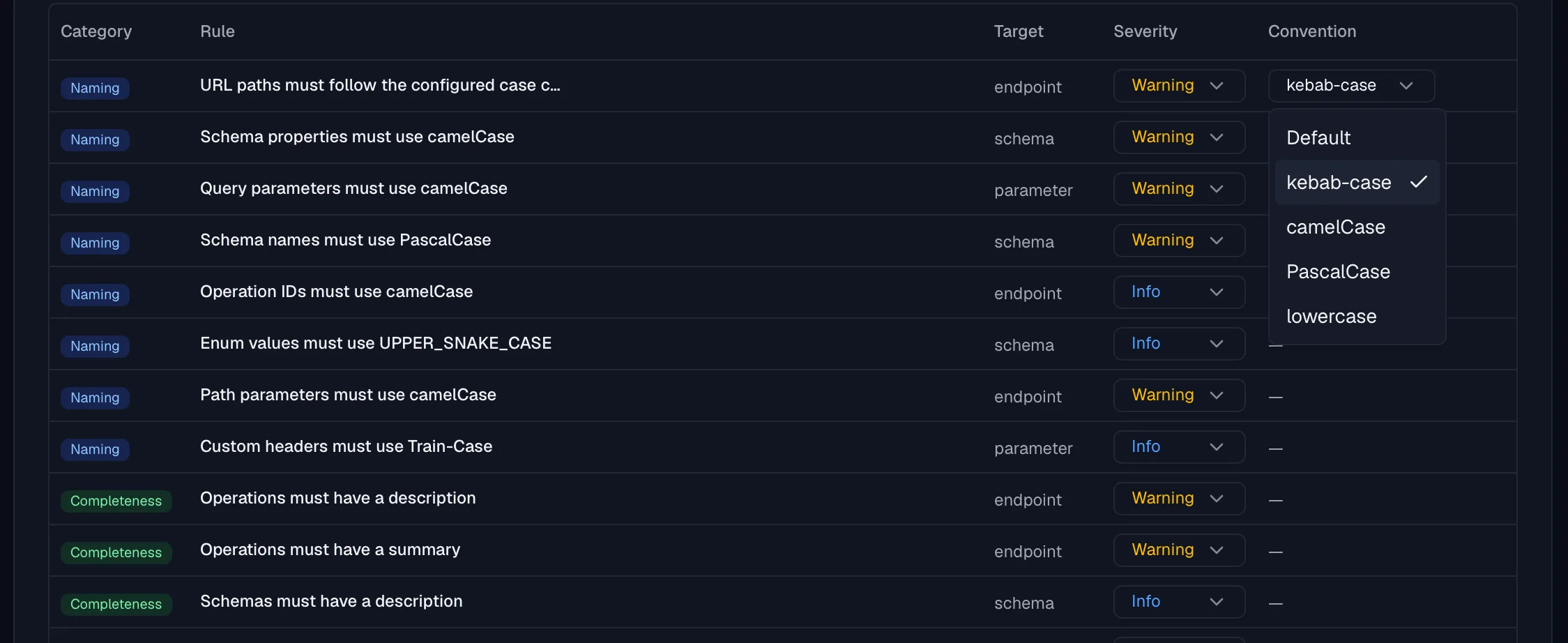
The style guide ships with rules across naming, completeness, best practices, security and structure, and each one is set to error, warning, informational or off. Severity is decided at organisation level and can be overridden per project, where a source column shows whether the current value is custom, inherited or the default. Blocking is opt-in, because enforcement on publish is off until you turn it on, and warnings never block. Configuring the guide needs the governance permission and it is a Pro plan feature.
Rules whose name says must are not automatically errors, since the name and the severity are set independently. That is worth knowing before you read the table as a list of things that will stop a release.
Violations surface where the work happens rather than in a report. An issues panel at the bottom of the designer groups them by rule, with severity counts that double as filters. Many issues carry a one-click fix, and a button applies all the available fixes at once. A summary badge sits in the header, the endpoint and schema tree carries badges with the violations in their tooltips, and the publish dialog lists what is left before a version is frozen.
Where a house rule has no built-in equivalent, custom rules cover a defined slice. A custom rule targets an endpoint, a schema or the specification, picks one field on that target, and matches with a regex, contains, equals or exists condition. That is enough for conventions about paths, summaries, operation identifiers and specification metadata, and it does not reach parameters, responses or status codes.
Reuse is the second mechanism. Components hold the shapes reused inside one specification, and an organisation-level shared library holds the ones reused across projects. Each specification keeps the library version it linked, so an update is something you accept rather than something that happens to you. Duplicate detection groups schemas by structure rather than by name, which is what finds the three teams that each wrote their own address type. Header policies do the same job for response headers.
The Style Guide, Shared Library and Header Policies guides cover the three surfaces, and the linting chapter of the OpenAPI guide covers the difference between a document being valid and being good. Applying the three across several teams rather than one API is the subject of the API governance guide.
Frequently asked questions
Why is consistency important in API design?
Because a consistent API can be learned once and then guessed. A caller who has integrated three endpoints already knows how the fourth pages its results, shapes its errors and names its fields, so each new endpoint costs them almost nothing. An inconsistent API has to be learned endpoint by endpoint, and the cost lands on every consumer rather than on the team that saved an afternoon.
How do you enforce API design standards across teams?
With three things rather than one. A written convention gives people something to agree on, reusable building blocks make the agreed shape the easiest one to use, and an automated check catches the cases where neither of those held. A style guide with no check is a document, and a check with no shared components makes people reimplement the same shape correctly over and over.
What is an API style guide?
It is the set of rules an API description is checked against, covering things like naming conventions, required descriptions, error response coverage and response shapes. Unlike validation, which asks whether a document is legal, a style guide asks whether it matches the way your organisation has decided to build APIs. It only does anything if it runs somewhere a person will see it.
Should API design rules block a release?
Some of them, eventually. Turning every rule into a blocker on day one stops work and trains people to bypass the check, while leaving everything advisory means the count of violations only grows. The workable path is to start advisory, fix the backlog, and then promote the small number of rules you are genuinely unwilling to ship without.
Last reviewed by The Routebase Team.